

Beyond Demolition
The left and right have plans to dismantle institutions they hate and both offer magical logic for their replacements. The consequences of this can mean lives lost.

From both ends of the political spectrum, it’s become more common to hear calls to demolish or dismantle long-standing institutions such as police forces, schools and other education agencies, international aid programs, and even democratic government. Advocates of these positions typically argue that these institutions have either always been corrupt or ineffective or that they once were useful but have become irredeemably corrupted over time. Whatever their view of this situation, their conclusions are the same—these institutions must go, and they must go now.
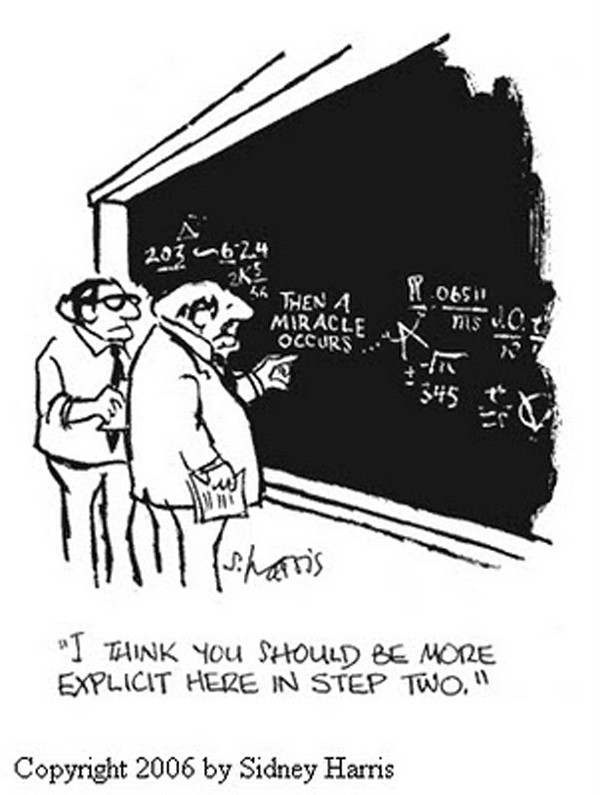
However, these advocates are often confronted with a question posed by skeptics and critics: if we tear it down, what will we replace it with? And the answer often involves some sort of magical thinking. For some, usually from the left—but not always—the answer is that we must reimagine something better. And from others, usually from the right, the response is that the destruction itself will unlock the door to a better world. In a way, both of these are variations of the “god of gaps” argument; that is, the gaps in our knowledge are attributed to miraculous acts of god. Except in this case, instead of God, the gaps are filled with vague utopian visions and untested assumptions. The problem with these views that prioritize destruction over the hard work of careful thought and building is that when put into practice, they can have enormous consequences. My argument here is simple—that we need to take this hard work of forming “a more perfect union” far more seriously.
Reimagining
The term 'reimagine' is especially popular on the progressive left (along with 'dreaming'), but the concept has been gaining ground on the right as well. I find nothing inherently wrong with reimagining or dreaming. It’s really good to question and think beyond the status quo. We never want to get stuck in the habit of doing things just because we’ve always done them that way, especially when that way is highly dysfunctional. And dreaming can help us set important aspirational goals and principles to strive towards.
All the problems with these concepts stem from the ways in which they are commonly argued for which often follows this path: declare an institution as corrupt or useless → call for its demolition → reimagination.
But maybe I’m strawmanning or overstating things. Given that I am in a mostly liberal bubble, I wanted to check my assumptions about the rise of reimagining, so I did a quick search in LexisNexis for the term’s frequency in the popular press over time. Not only has its use increased sharply, but it has also coincided with the time others have pointed out that social activism started to spike around 2013-2015.

This provides some evidence of a change. Still, when people make the kinds of arguments I’m making, there is usually the “nobody is saying that” pushback. So it’s helpful to get concrete.
Abolish the Police
Anyone in the US not living under a rock knows that in the early days following the killing of George Floyd, there were many calls for abolishing the police. Like many others, I found this idea extreme and counterproductive for accomplishing the advocates’ stated goal of saving Black lives. How would getting rid of police forces help those who are being disproportionately killed by community violence, I thought? This confounded many others as well, and at almost every turn, the rationalization I heard from sympathizers of the activists was, “No one literally means getting rid of police!” (note the “no one is saying” language I mentioned earlier). They mean reforming accountability structures, funding, and police training, they said.
But then this came out in the New York Times:
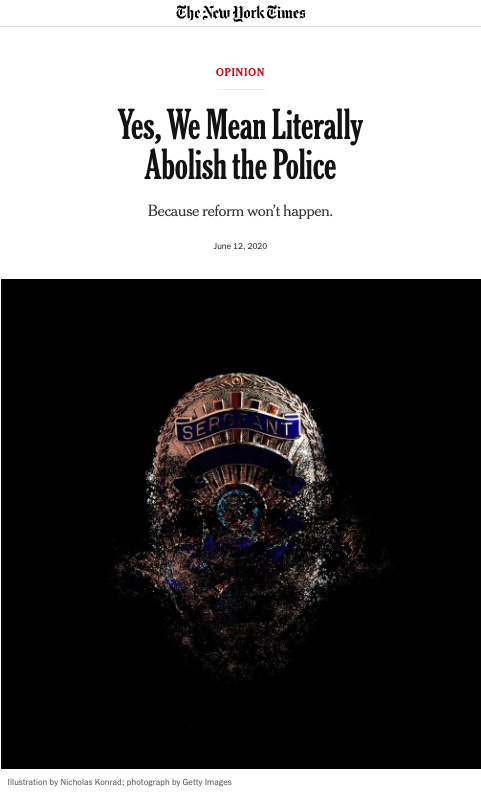
So yes, at least some with influence in shaping the national narrative took the issue of police abolition quite seriously and literally. And their vision for replacing it primarily involved things like community-based programming, restorative justice approaches, and mental health professionals responding to crisis calls. You can see this dynamic play out in this conversation between academics Glenn Loury, John McWhorter, and Vincent Lloyd. When Lloyd argues for the dismantling of carceral systems, McWhorter asks him about the concrete steps for replacing them, and Lloyd’s response points to the above solutions, but his argument is far less developed than his articulation of the problems and the need for dismantling.
I would never want to shut any of these proposed solutions down as potential adjuncts to policing. Some of these practices, such as bringing mental health professionals to police visits, are being tested and may prove effective under certain conditions. But suggesting them as replacements means the proponents have the hard work of demonstrating that these things will protect the many innocent families living in fear in high-crime communities in a way that is better than policing. And given that literal lives are on the line, the evidence needs to be of the highest order.
Unintended Consequences
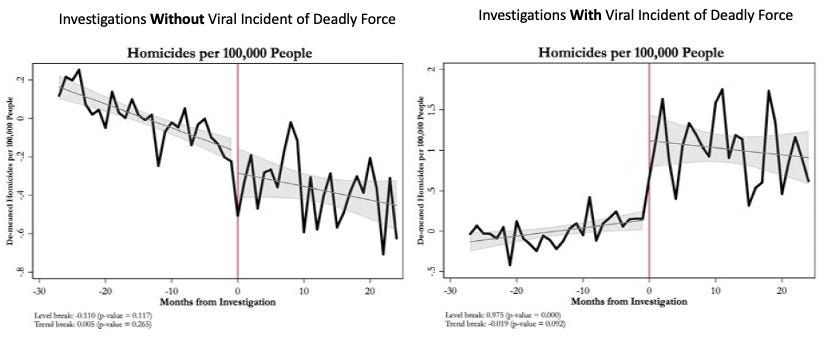
Sometimes, there are unintended consequences for just threatening to destroy an institution like the police. And there is good evidence that this may have been the case with the “abolish the police” movement. The graphs below are from a rigorous study by economists Tanaya Devi and Roland Fryer showing changes in homicide rates in 20 cities where investigations of police misconduct didn’t go viral (left) and in five cities where they did (right; “viral” means investigations in cities that gained national attention and witnessed protests and riots). Devi and Fryer’s theory for why homicide increased in cities with viral incidents is that the virality of the investigations led to police withdrawing proactive policing out of fear of becoming the target of a viral media attack.
The Magic Chainsaw (and Wood Chipper)

Others, usually on the right, take a far less lofty and utopian approach than reimagining. In many cases, it hardly seems to involve any imagination whatsoever. But it’s no less magical in its logic. The vision they put forward is that, following the destruction of an institution, things will just work themselves out, as if the dust from the destruction were enchanted, and when it settles, all will be right with the world again. In this worldview, destruction and reimagination are fused; destruction actually creates the better world we want and need. Therefore, rather than offering vague, untested solutions, they offer vague visions of what will spring from the ruins. We don’t need to create it; the prosperous world we all desire is just on the other side of this monstrous barrier!
This was likely the view guiding Musk when he bragged about spending his weekend feeding the US Agency for International Development (USAID) “into the wood chipper”. Since USAID was all downside, getting rid of it would be all upside. We’d start getting rid of all of the fat that’s been weighing down our trip to prosperity.
Unlike abolishing the police, the abolition of the USAID agency actually happened just as intended, and the consequences were far worse and less ambiguous. While people likely died as a result of the “abolish the police” efforts (at least 900 estimated lives lost), the fact that the USAID abolishment was successful resulted in deaths that were orders of magnitude higher than attempts at dismantling the police. There is some controversy around the estimates of those who died as a direct result of eliminating USAID staff, terminating most of its contracts, and impounding its funding, but at least a few hundred thousand have died, and some estimate that this number could eventually run into the millions. Despite Marco Rubio’s claim that “no one died” from the cuts, it turns out that when you immediately stop providing life-saving services and resources without warning to high-need populations, people do, in fact, die. A lot of them.
The Real Work
Trying to abolish the police and actually abolishing USAID were just two examples of magical abolitionist intents, but others abound. Some on the left have called for abolishing schools and dismantling systemic racism by establishing an all-powerful, authoritarian federal department. The right has been especially enthusiastic about demolition, calling for the abolition of a host of agencies, including the US Department of Education, the FBI, and the IRS (to name a few). The most disturbing of all the abolitionist arguments from the left or right is Curtis Yarvin’s call to replace Democracy with Monarchy, a view increasingly taken seriously by the right.
Not all calls for dismantling are unreasonable, though. Could we have an effective education system without a Department of Education? Possibly—it’s only 45 years old. But it would require a well-developed plan for how the Department's important functions would be covered by other agencies—a plan that has only recently been hazily articulated. The problem is not arguments for abolition, it’s doing so unseriously with insufficient attention to the consequences.
The point has been made many times that it's far easier to tear down than to build, and the lesson is that we need to devote far more energy to the latter. But this lesson is often ignored, with magic substituted for the real hard work of institutional maintenance and construction. This is especially problematic when performed by those responsible for governing.
What would it actually take to do this differently? It seems to me that taking four things more seriously would be an enormous improvement over the rise of magical thinking.
Take an honest inventory. What does this institution actually do that people rely on? Not what it claims to do, not what we wish it did, but what functions it performs that would leave gaps if eliminated. When police withdraw from proactive policing, who responds to domestic violence calls at 2 AM? When USAID shuts down, who distributes anti-malarial drugs in Uganda?
Provide concrete specifications. Not ‘reimagine public safety’ or ‘return education to the states’—actual details. Which specific organizations respond to which specific situations? How are they funded? Who trains them? Who oversees quality? Who handles failures? And who will be accountable for failures?
Provide evidence for the effectiveness of alternatives. Not thought experiments, not small pilot programs, not correlational studies—evidence at scale that the proposed replacement can perform the critical functions better. Crisis intervention teams might work for some calls. Can they handle all the calls the police currently handle? Show the evidence. Likewise, if your argument is that all will be fine without agencies like USAID, show the evidence before beginning demolition.
Create transition plans that manage adverse effects. The USAID elimination was a case study in how not to do this—immediate termination of contracts, no handoff of critical services, people dying within weeks. The Devi and Fryer research suggests that even threatening institutional elimination without clear alternatives can have deadly consequences.
This work is unglamorous and doesn’t inspire any rallies. It requires talking to people who run these institutions (not just the people who hate them), accepting incremental progress over revolutionary rhetoric, and disappointing people who want immediate perfection.
But it’s the only approach that actually protects the vulnerable populations both left and right claim to champion. The Constitution’s framing of ‘A more perfect union’ says it well. Not a perfect union. A more perfect one. The work of reform is never finished, and it’s always harder than the work of demolition. But when the alternative is watching people suffer or die while we wait for miracles to emerge from the rubble, we should commit to that harder work.
I think it's a bit generous to presume that the homicide rate went up because police didn't engage in proactive policing. Even in the best of times, police are loathe to do their job if they don't feel like it, as anyone who has attempted to call them to report a crime can attest, and I can't imagine they were in the mood to any more than the bare minimum when citizens had the temerity to protest their behavior. Besides that, we all know they massage the crime data for their own political purposes- this was the whole premise of Trump's takeover of D.C. And The Wire, for that matter.
I'm likewise skeptical of any claims that destroying USAID cost lives in the aggregate. Not all of the USAID money was being used to benignly supply anti-malarial medication. Programs like that have always been a cover for other USAID programs deliberately designed to destroy and subvert foreign governments. USAID programs, much like the police, aren't actually accountable to anyone. If they were, this level of protest wouldn't have been necessary because people could have just reported their grievances and had faith they would have been taken seriously.
You can't just take the institution's word for it that the institution is good. What's the difference between democratic institutions and totalitarian ones if that's the standard we're supposed to use?